Sunday, 29 November 2015

RECALCULATIONS ON PEACE AND EMERGING NATIONS

What’s up?
The high development rate and global support for peace operations in both regional and global spectrums demonstrated by the emerging nations are true legendary moves when we consider their historical backgrounds of violence and political instability, but astonishingly, these emerging nations are well-known for their high levels of corruption within their internal economic management processes as accessed by transparency international.
  • Is it probable to say that corruption is a considerable factor for development or is it merely the social construct of such societies that make them gain rapid progress within their corrupt atmospheres?
  • Since this corruption packed emerging nations show a strong value and spirit of peaceful development within their territorial limits and across other countries within regional dimensions, can we argue whether corruption is a factor of peace?
What’s Down?
In several occasions and in many philosophical viewpoints, corruption has been defined as a total destroyer of development and disrespect for human rights thus a high conflict making catalyst. The worry here now is, in the advent of these emergent nations’ to a world order, either through the formation of the BRICS bank or through their highly influential regional peace initiatives and bilateral economic cooperation with other less developed and more vulnerable countries:
  1. Wouldn’t these vulnerable countries’ situations become worse from the induced corruption habits they may copy from their benefactor nations?
  2. Are the poor regional countries which seek development assistance and politico-economic entrepreneurship from the corrupt emerging nations institutionally apt enough to withstand the impacts of copied flawed economic systems?
  3. Are there other probable mechanisms for collaborative development exchanges between the emerging nations and the developing countries without copying their corrupt practices?
MAHSRA also indicates that it is presently undergoing a series of research works on gender equality intervention schemes and best ways for integrating pragmatic gender equality policy development and direct peace activity growth within local, national, intergovernmental, and international frameworks. And thus, is highly soliciting support from the public.
To support and/or partner with MAHSRA and still obtain a specialized copy of this document this MAIL option is very useful. 
The subject of the mail should be: Recalculations on Peace and Emerging Nations
Direct copies are also available at: Amazon
Author’s Profile at:  Dr. Kelly NGYAH 
and Connect to Author's Linkedin
Note:   
  • By obtaining a copy of this document through the support link or email, you are directly partnering as one of the supporters/donors of MAHSRA’s Peace Initiatives. As such, you may confirm in writing to us to let us know if your name should be included and/or published within the organization’s funders’ bulletin. This list may become periodically published on the website as soon as necessary
Your comments, Recommendations and Positional Conceptions are Welcomed
Enter Discussion Forums of this work at: MAHSRA FORUMS

Please You can also show support by using the sharing tools below to extend on facebook, google and more.  
Thanks for Your Invaluable Support

PROBABLE HURDLES IN CAMEROON’S 2035 DREAM


What’s up?
The nation of Cameroon is taking a very giant step forward through the President’s recent ‘greater ambition’ policy discuss that is already in its manifestation phase within the growth and employment strategy paper 2010/2020 and an emerging nation policy plan to be realized by 2035. Yet as realistic as the great policy seems on its road to realization, it at the same time pulls along the ambivalent dynamics that are fundamental prerequisites for such a development perspective and that have been posing intriguing worries upon the current political and cultural stability.
  • Are such heavy macro-economic advancement measures truly feasible for sustenance meanwhile there are still severally pronounced worries upon citizenry contentment?
  • If we pretend to cover what we know still worries us in the name of huge growth and investments are we certain to sustainably protect such investments when we feel fully cheated in our own well-being needs?
  • Can a civil uprising maintain and sustain the country’s vision as the present regime in a virtual peaceful spectrum proves? 

What’s Down?
The ‘emergence of a nation is strongly bestowed on its human development capacity to deliver such emergent goals but if this human development aspect is not rightly targeted, then there is a problem.
‘Where is the citizen’s place in this huge development plan?’
Great economies are built to and for the service of men, thus, these men ought to be also mentally, morally and physical apt to effectively enjoy and sustain the fruits of such economies else they become futilitarian ventures prone to destruction and regression rather construction and progression.
  1. Where are the instituted and enforcement procedures to protect the human development plan of the Cameroonian people towards acknowledging and maintaining their peaceful nature?
  2. Can the present education culture of bribery and civil alcoholism sustain our national structures and vision in the case of an uprising?
  3. What non-personal measures would you propose to our government to face the actual worries of its citizens in order to avoid futuristic violent and destructive conflicts?
  4. What do you think the proper sustainable development plan of Cameroon should entail?
MAHSRA has proposed the need for the government to institutionalize and invigorate an educational culture of peace and civics from a rudimentary level and up to the most advanced levels in a case venture wherein each Cameroonian should be able to consider his/her self as a learned peace maker.  From there on, the national citizenry shall all in one way or the other be actively involved in building and sustaining the ‘nation of the dream’  


MAHSRA also indicates that it is presently undergoing a series of research works on gender equality intervention schemes and best ways for integrating pragmatic gender equality policy development and direct peace activity growth within local, national, intergovernmental, and international frameworks. And thus, is highly soliciting support from the public.
To support and/or partner with MAHSRA and still obtain a specialized copy of this document this MAIL option is very useful. 
The subject of the mail should be: Probable Hurdles in Cameroon's 2035 Dream
Direct copies are also available at: Amazon
Author’s Profile at:  Dr. Kelly NGYAH 
and Connect to Author's Linkedin
 Note:   
  • By obtaining a copy of this document through the support link or email, you are directly partnering as one of the supporters/donors of MAHSRA’s Peace Initiatives. As such, you may confirm in writing to us to let us know if your name should be included and/or published within the organization’s funders’ bulletin. This list may become periodically published on the website as soon as necessary
Your comments, Recommendations and Positional Conceptions are Welcomed
Enter Discussion Forums of this work at: MAHSRA FORUMS

Please You can also show support by using the sharing tools below to extend on facebook, google and more.  


Thank You for Your Support

Saturday, 28 November 2015

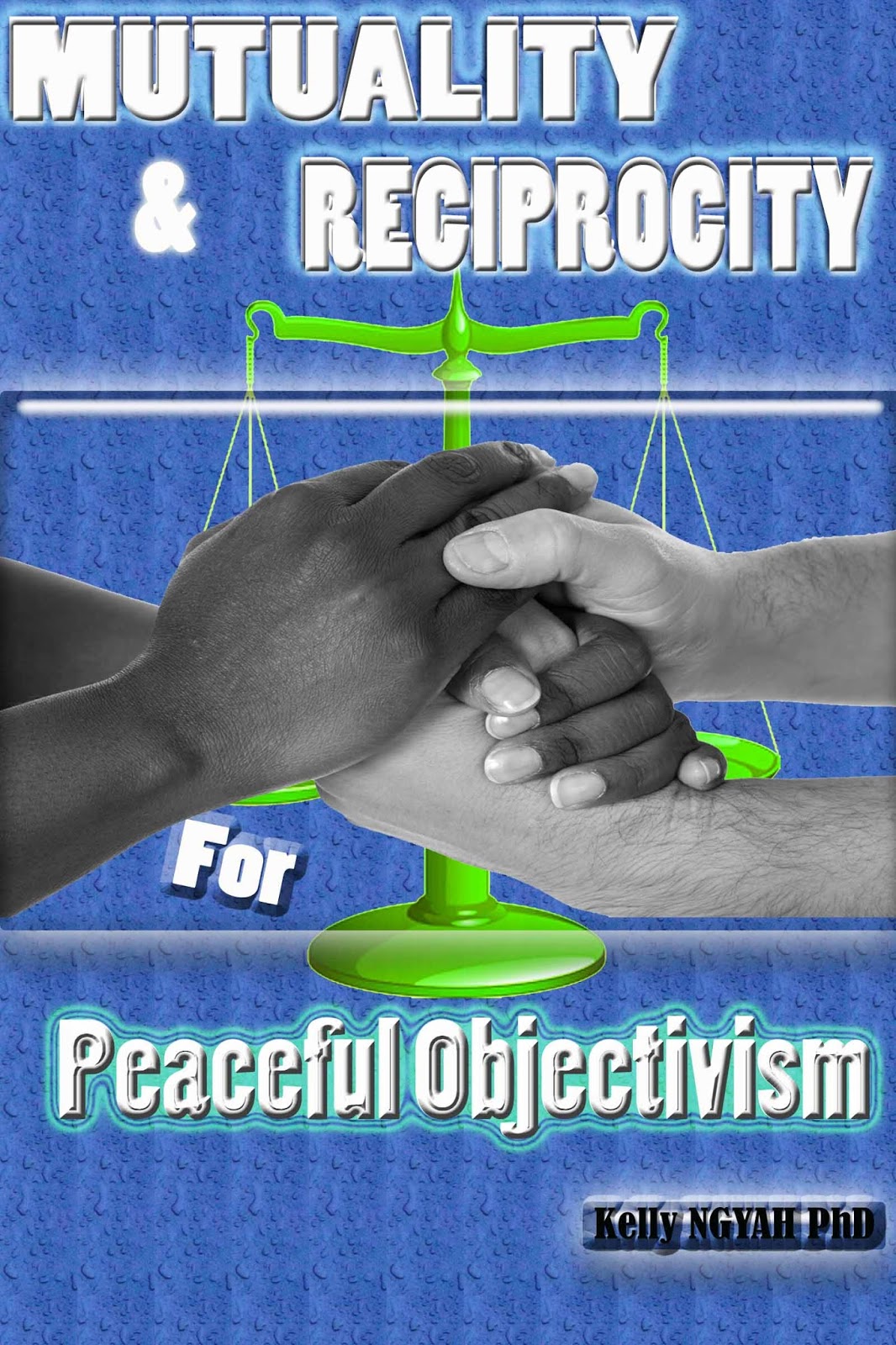
MUTUALITY AND RECIPROCITY FOR PEACEFUL OBJECTIVISM

What’s up?
Rand’s utopian perspectives of objectivism direct us in the sense of a world that no wrong should or could be done to another if all is in a perfect objective state. At the same time, it promotes highly egoistic individualism values on the quest for self-satisfaction through perceptive reasoning for a free competitive political and economic world that promotes highly rated individual liberties which are only restricted within the individual’s perceptive mind and not necessarily in respect to others.
  • If the individual’s perceptive reasoning is of no real objectivist value to a third party, how then can mutuality and reciprocity be appreciated towards peaceful development initiatives?

What’s Down?
As unrealistic as Rand’s objectivism concept for peace may seem, the one important note to take home is that it serves to pull the individual under the judicial jurisdiction of his/her ethical moral conscience. Yet, this is still another problematic―owing that, the values of different persons’ consciences may not be equal because all persons were not nurtured and/or cultivated in the society following the same principles and no two persons have exactly the same thoughts.
  1. If certain values are considered a reality in one society and are not accepted as such in another, how can peace building moves be possible between such societies?
  2. The deployment of reciprocity issues within a conflict moment kills the value of tolerance and may ignite more injury than expected, what does it take therefore to appease mutually injured conflicting parties?
  3. When strict objectivism seems unachievable, uncontrolled reciprocity troublesome and direct mutuality dubious, what else do we have to ascertain peace in a post-conflict situation?

However, peaceful objectivism remains the most precious value in human development discourses, because in one way or the other, it sets in the pace for a more realist and durable peace mechanism since it has to do with the individual’s, rather than an institutional perception of durable peace. (Institutions only set the pace for the fulfillment of individual goals―thus, achieving such goals at the individual level provides for the reality dream in its self)     
MAHSRA also indicates that it is presently undergoing a series of research works on gender equality intervention schemes and best ways for integrating pragmatic gender equality policy development and direct peace activity growth within local, national, intergovernmental, and international frameworks. And thus, is highly soliciting support from the public.
To support and/or partner with MAHSRA and still obtain a specialized copy of this document this MAIL option is very useful. 
The subject of the mail should be: Mutuality and Reciprocity for Peaceful Objectivism
Direct copies are also available at: Amazon
Author’s Profile at:  Dr. Kelly NGYAH 
and Connect to Author's Linkedin
 Note:   
  • By obtaining a copy of this document through the support link or email, you are directly partnering as one of the supporters/donors of MAHSRA’s Peace Initiatives. As such, you may confirm in writing to us to let us know if your name should be included and/or published within the organization’s funders’ bulletin. This list may become periodically published on the website as soon as necessary
Your comments, Recommendations and Positional Conceptions are Welcomed
Enter Discussion Forums of this work at: MAHSRA FORUMS
Please You can also show support by using the sharing tools below to extend on facebook, google and more.  


Thank You for Your Support

Wednesday, 13 May 2015

FACING GENDER VIOLENCE AND OUR ROLES TO COMBAT SEXUAL ABUSES AGAINST WOMEN


Leadership Responsibilities

What’s Up?
Though continuous assessments on the degrading human rights status of women around the world and most especially within vulnerable communities have demonstrated the need for increased and effective actions in combating gender violence, the factor of ignorance is still playing a predominant role in promoting this ill.

  • Is it that the community men’s ego and greed will not permit their vulnerable community women to evolve and equate with them or is it that they are ignorant on how to go about it?
  • In another regard, is it possible for us to say that, global policies require that gender violence through gender equality be eradicated but, on the other way round the policy implementers lack the will to do so?

Though we may also acknowledge numerous efforts from diverse sectors have been made combat the flaw, it cannot be denied there is an obviously relaxed community and local government attitude towards eliminating or combating the prejudicial natures of such gender violence acts.

  • If all societal and community leaders are considered as lead elements for global and nationally accepted development objectives, what then could be the reasons behind their laxity and lapses? And how can these be remedied?  

What’s Down?
With an intrinsic understanding that global and community led development success stories can only be achievable through combined efforts of all involved or concerned parties, a new methodology for approaching sensitive gender equality issues such as the eradication of gender violence and probable sexual abuses against women should entail strategic definitions and enactment of individual obligations towards the combat of the flaw. If these measures are to be effectively implemented then certain worries need to be addressed before.

  1. What ways can we get the vulnerable and ignorant community women to understand what the legal qualifications of gender and sexual violence issues mean in their locally understood context?
  2. What protection dispositions can be put in place to effectively cover victims and those who denounce chronic and dangerous perpetrators of gender and sexual violence ills within the society
  3. What mechanisms and procedures can be put in place to ensure that leadership responsibilities are frequently addressed and recalled by the vulnerable community dwellers?
  4. What motivational community factor can be put in place to promote general individual participation in combating the flaw? 
The author, Dr. Kelly NGYAH, within this literary piece, presents the UN conventional comprehensiveness opportunity on involved terminologies, typologies and implicative measures that are required to properly understand and engage community led initiatives to combat gender violence and sexual abuses against women.

MAHSRA also indicates that it is presently undergoing a series of research works on gender equality intervention schemes and best ways for integrating pragmatic gender equality policy development and direct peace activity growth within local, national, intergovernmental, and international frameworks. And thus, is highly soliciting support from the public.
To support and/or partner with MAHSRA and still obtain a specialized copy of this document this MAIL option is very useful. 
The subject of the mail should be: Widows and Widowhood, From Rites to Rights
Direct copies are also available at: Amazon
Author’s Profile at:  Dr. Kelly NGYAH 
and Connect to Author's Linkedin
 Note:   
  • By obtaining a copy of this document through the support link or email, you are directly partnering as one of the supporters/donors of MAHSRA’s Peace Initiatives. As such, you may confirm in writing to us to let us know if your name should be included and/or published within the organization’s funders’ bulletin. This list may become periodically published on the website as soon as necessary
Your comments, Recommendations and Positional Conceptions are Welcomed
Enter Discussion Forums of this work at: MAHSRA FORUMS
Please You can also show support by using the sharing tools below to extend on facebook, google and more. 

Thank You for Your Support

WIDOWS AND WIDOWHOOD: From Rites to Rights


Leadership Roles and Responsibilities
What’s Up?

Widows’ plight within countless communities throughout the globe is seemingly one of the most over glaring situations wherein customary practices, traditions and rites which are duly protected by national laws have at the same time severely infringed the same laws and other leader international dispositions.
  • Is it right for people to claim cultural rights wherein some fundamental human rights principles are severely violated?  
Protecting the customs of the local or traditional people forms the existential essence and rich diversity of such peoples. However, when these customs become very discriminatory wherein a particular sex is forced to undergo inhumane practices in order to demonstrate loyalty towards another meanwhile in a reversed case the same does not apply, a problematic is posed within the existentialist and protective rights of such customary norms and universal principles of equality with regard to ethics and mores.
  • What can we do when such a problematic surfaces in order to stay in conformity with legality?
  • Dot we violate one valued norm in order to protect the other or do we use the improvised intelligence of equity?

What’s Down?

In very obvious situations, the rule of law has often prevailed, the value of human life and inherent dignity happens to be the most cherished jus cogens or international peremptory norm.  The conceptualized meaning and notion of being a widow within traditional societies and being forced to undergo some or more of the mentioned examples of barbaric widowhood rites practices within the book in case study is clear prove of situations that violate the rights of the woman and her human dignity and integrity.  This means violating internationally peremptory norms over locally amendable societal mores.  Even when such locally made and adjustable customs are understood to impose adverse multiplier effects on the orphaned children of widow victims which may as well distort their community love and development zeal; it is still very amazing and shameful to watch how local law making bodies and enforcement authorities would sit back and even have or watch such illegal widowhood rites practices perpetrated within their communities and as well in their families.
  1. Do we have adequate knowledge about the obligation of State parties with respect to ratified international norms and what state or government authorities have the duty to do regarding communities and individuals perpetrating barbaric widowhood rites practices?
  2. When such situations are assessed can we attribute it to ignorance, to ill-intent, or simply to incompetence?
  3. Is there any excuse for ignoring the law? If not can we therefore indict law making bodies and law enforcement authorities for failing to uphold their duties?
  4. When public institutions fail in their duties uphold the law, are the legally instituted civil society partners aware of the opportunities they have within international dispositions to claim required support from such public bodies in order to assist implement their failed obligations?
While the brief literary piece in concern exposes some of the exemplary psychological, socioeconomic and rights-based worries that damage the well-being and inherent dignity of a victimized community widow and her orphaned children, it as well serves as a cautionary guide to public authorities in dealing with widowhood rites related issues and a facilitative medium for civil society activist towards in gaining government support for their activism  ventures to assist vulnerable community widows.

MAHSRA also indicates that it is presently undergoing a series of research works on gender equality intervention schemes and best ways for integrating pragmatic gender equality policy development and direct peace activity growth within local, national, intergovernmental, and international frameworks. And thus, is highly soliciting support from the public.
To support and/or partner with MAHSRA and still obtain a specialized copy of this document this MAIL option is very useful. 
The subject of the mail should be: Widows and Widowhood, From Rites to Rights
Direct copies are also available at: Amazon
Author’s Profile at:  Dr. Kelly NGYAH 
and Connect to Author's Linkedin
 Note:   
  • By obtaining a copy of this document through the support link or email, you are directly partnering as one of the supporters/donors of MAHSRA’s Peace Initiatives. As such, you may confirm in writing to us to let us know if your name should be included and/or published within the organization’s funders’ bulletin. This list may become periodically published on the website as soon as necessary
Your comments, Recommendations and Positional Conceptions are Welcomed
Enter Discussion Forums of this work at: MAHSRA FORUMS
Please You can also show support by using the sharing tools below to extend on facebook, google and more. 

Thank You for Your Support